April 28, 2026 · Variant Systems
Reverse DNS (PTR) Records: The What, Why & How for Founders
DNS isn't just about pointing names to IPs. Reverse DNS is the invisible handshake that keeps your emails out of spam and your infrastructure reputable.
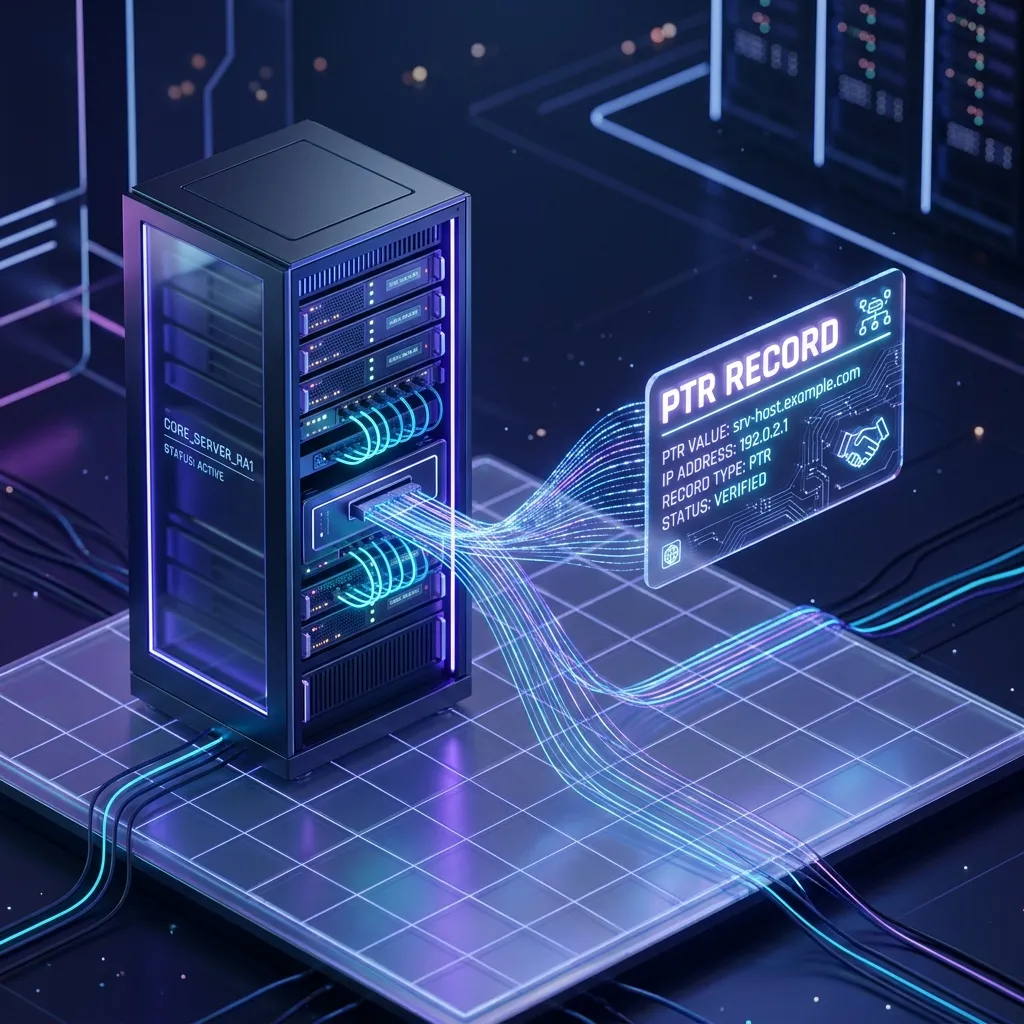
Most founders focus on the “Forward” side of their business: the brand, the landing page, and the product. In the world of DNS, this is the A Record—mapping your beautiful domain name to a boring IP address.
But there is a “Reverse” side that most people ignore until their transactional emails start bouncing or their server gets blacklisted. This is the PTR (Pointer) Record, and it’s the closest thing the internet has to a mandatory “Reverse Caller ID.”
What exactly is a PTR Record?
If an A Record is like looking up a person’s name in a phone book to find their number, a PTR Record is the opposite. It’s taking a phone number and asking, “Who actually owns this?”
In technical terms:
- A Record:
example.com→192.0.2.1 - PTR Record:
192.0.2.1→mail.example.com
This is known as Reverse DNS (rDNS). It’s a way for other servers on the internet to verify that the IP address claiming to be “you” is actually authorized to use your name.
Why should you care? (The “Founder’s Pain” Edition)
If you are a founder building a product, you might think, “I use Postmark/SendGrid/Resend, why do I care about server-level DNS?”
Here is why:
1. The Spam Filter Gauntlet
Major email providers like Gmail, Yahoo, and Outlook perform a “Forward-Confirmed Reverse DNS” (FCrDNS) check. If your server sends an email, they look at the IP, check the PTR record, and then check if that PTR record points back to the same IP.
If this loop is broken—or if the PTR record is missing—your “Important Password Reset” email is headed straight to the junk folder. Even if you use a third-party sender, understanding this plumbing is crucial for your own internal toolings, staging environments, and custom mail servers.
2. Security and Logging
When your systems talk to each other, or when you’re auditing logs after a security incident, seeing web-prod-01.example.com is infinitely more useful than seeing 157.245.12.89. Many security tools automatically discard traffic from IPs that don’t have a valid, matching PTR record.
3. B2B Credibility
If you are selling into the Enterprise, their IT departments will scan your infrastructure. A missing PTR record is often flagged as “amateur hour”—a sign that the infrastructure was “vibe-coded” without attention to the underlying standards of the web.
The DigitalOcean Quirk: The “Wait, WHAT?” Moment
Most cloud providers (AWS, GCP, Azure) make you jump through hoops to set up a PTR record. You have to find a specific “Networking” or “Reverse DNS” tab, wait for propagation, and sometimes even open a support ticket.
DigitalOcean does it differently.
In DigitalOcean, the PTR record for your Droplet is automatically set based on the Droplet’s name.
If you name your droplet api.yourstartup.com when you create it, DigitalOcean automatically creates a PTR record for that Droplet’s IP pointing to api.yourstartup.com.
The “IKR” Reality Check
This is incredibly convenient, but it leads to a hilarious (and dangerous) quirk: Accidental PTRs.
If you name your droplet test-server-dont-use-this-is-garbage, your Reverse DNS will literally say: 157.245.12.89 → test-server-dont-use-this-is-garbage.
If you then start sending emails from that IP, spam filters will see that “Garbage” hostname and treat you accordingly.
Pro Tip for Founders: Always name your Droplets using their Fully Qualified Domain Name (FQDN) like mail.example.com or web.example.com. Don’t use nicknames like batman or production-v2-final-final.
How to check your PTR Record right now
You don’t need a fancy tool. Just open your terminal and run:
# Replace with your server's IP
dig -x 143.110.186.100 +short
Or the simpler:
host 143.110.186.100If the result is a generic hostname provided by your ISP (like 12-89-245-157.static.digitalocean.com), you haven’t set it up correctly yet.
Infrastructure as Craft
At Variant Systems, we believe that Judgment is the new Headcount. It’s easy to spin up a server with an AI agent; it’s much harder to ensure that server actually adheres to the decades of “invisible” protocols that keep the internet running smoothly.
Don’t let your “Day-One Legacy” start with broken DNS. Take five minutes to check your PTR records. Your deliverability—and your reputation—will thank you.