April 28, 2026 · Variant Systems
Vibe Coding is Not an Architecture: 5 Platform Pitfalls for Founders
AI speed is a competitive advantage until it becomes a production liability. We analyze common traps in AI-generated infra across Vercel, Supabase, and Stripe.
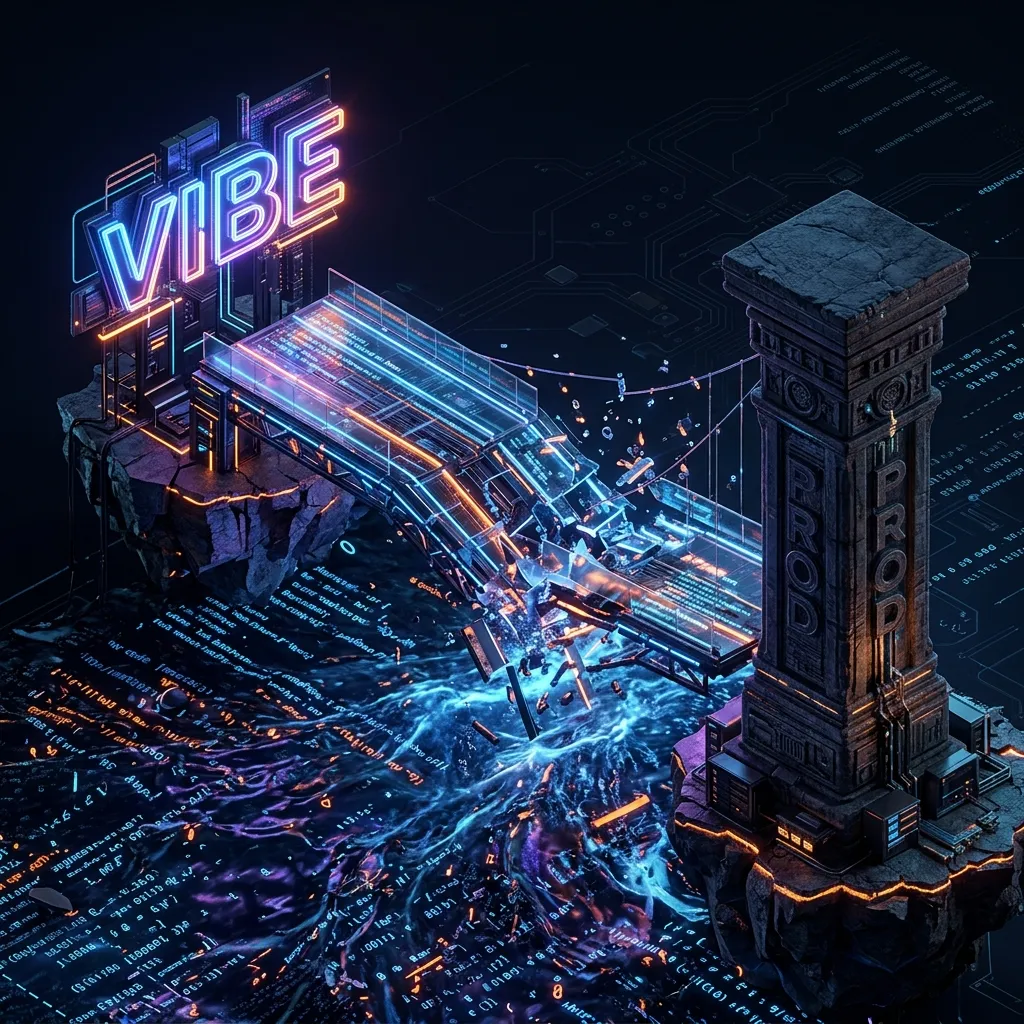
“Vibe Coding” is the founder’s new superpower. You describe a feature, an AI agent generates the code, and ten minutes later, you’re looking at a working prototype. It feels like magic. It feels like the end of the “Accountability Sink.”
But speed is a drug, and technical debt is the hangover.
The problem with AI-generated code isn’t that it’s “bad”—it’s that it’s context-blind. AI models are trained on the “Happy Path.” They optimize for the immediate vibe of a working UI, often at the expense of the boring, invisible infrastructure that keeps a business alive at scale.
If you are a founder going “all in” on vibe coding, here are the platform-specific pitfalls that will eventually break your heart.
1. The Vercel “Serverless Wall”
AI agents love heavy dependencies. If you ask an AI to “handle PDF generation,” it might pull in a massive library like Puppeteer and write a 50MB function.
The Pitfall: Locally, this works fine. In production on Vercel, you hit the Serverless Wall.
- Cold Starts: Your users wait 10 seconds for the function to wake up.
- Execution Limits: Your function times out before the PDF is finished.
- Memory Overhead: You exceed the 1024MB limit, and the function simply crashes.
AI doesn’t know you’re running in a resource-constrained serverless environment unless you specifically tell it to optimize for it. It writes for a “Server,” but you’re deploying to a “Function.”
2. The Supabase “N+1” Mirage
AI is excellent at writing a single SQL query. It is terrible at understanding how that query behaves when your database grows from 10 rows to 10,000.
The Pitfall: A common AI pattern is to fetch a list of items and then, in a loop, fetch the “Owner” for each item. This is the classic N+1 Query Problem.
- Local Vibe: You have 3 users. It makes 4 database calls. It’s instant.
- Production Reality: You have 500 users. It makes 501 database calls. Your Supabase dashboard turns red, your CPU spikes to 100%, and your app grinds to a halt.
Without human intuition to say, “Wait, we should use a SQL Join here,” the AI will happily vibe-code your way into a database meltdown.
3. The Stripe “Ghost Payment”
This is the most dangerous one. When you ask an AI to “Integrate Stripe Webhooks,” it will produce a handler that listens for payment_intent.succeeded and updates your database.
The Pitfall: AI frequently forgets Signature Verification and Idempotency.
- Security: Without signature verification, anyone can send a fake POST request to your
/api/webhookand grant themselves a Lifetime Pro subscription. - Reliability: Stripe sometimes sends the same webhook twice. Without idempotency checks, your AI-generated code might double-count a transaction or trigger two welcome emails.
4. The “Works on My Machine” CORS Loop
We see this constantly in our Code Audits. An AI hits a Cross-Origin Resource Sharing (CORS) error and, to “fix” it, it suggests setting your headers to Access-Control-Allow-Origin: *.
The Pitfall: This “fixes” the bug, but it opens a massive security hole. It allows any website on the internet to make requests to your API using your users’ browser credentials. It’s the ultimate “vibe fix” that trades long-term security for immediate satisfaction.
5. The “Context Window” Architectural Rot
As your project grows, the AI’s “Context Window” becomes a liability. The AI starts forgetting how Module A works while it’s writing Module B.
The Pitfall: You end up with Architectural Schizophrenia.
- Half your app uses
fetch, the other half usesaxios. - Some state is in
React Context, some is inZustand. - Error handling is robust in one file and non-existent in the next.
This is Day-One Legacy. It’s code that was born yesterday but is already unmaintainable because there is no consistent “Intent” behind the architecture.
The Solution: Technical Judgment
Vibe coding is a tool, not a strategy. The goal isn’t to stop using AI—it’s to stop delegating Accountability.
At Variant Systems, we act as the “Technical Judgment” for founders who are moving fast. We don’t just write code; we own the architecture. We bridge the Verification Trap by auditing AI-generated systems to ensure they don’t hit the “Serverless Wall” or the “N+1 Mirage.”
If you’re building with AI, don’t just code the vibe. Build the foundation.
Let’s talk about how we can audit your current codebase before the “Happy Path” ends.